About the project
Astro Rocket, created by Hans Martens — web designer and developer from Veghel, the Netherlands — is a production-ready Astro 6 starter that ships as a complete, styled website, not a blank slate. Clone it, update the text, go live. Everything else is already done.
It covers everything a serious portfolio or marketing site needs: a full design system, 57+ components, 12 live-switchable colour themes, a 3-state colour-mode system, a full blog with MDX, projects, content collections, the complete SEO stack, RSS, sitemap, structured data, native opt-in i18n, a contact form wired to Resend, a newsletter form, Pagefind search, cookie consent with Google Consent Mode v2, and a layered animation system — all wired together, all working on day one. Long-form blog posts get an auto-generated table of contents and Giscus-powered discussions; header and footer navigation are configured independently.
It scores 100 on every Lighthouse category out of the box. It’s built for designers, freelancers, and developers who want a site that genuinely impresses from the moment it launches.
Not a blank slate. A complete, styled website that ships on day one.
Lighthouse: 100 Across the Board
Astro Rocket scores 100 on every Lighthouse category — Performance, Accessibility, Best Practices, and SEO — on the live demo at astrorocket.dev. That’s not a tuned benchmark page; it’s the full site with animations, a theme switcher, typed headlines, a contact form, the cursor trail, and the LetterGlitch CTA.
Lighthouse runs in a sandboxed Chromium environment with throttled CPU and network, so individual scores can vary a point or two from run to run depending on the host machine, network conditions, and which extensions or processes are competing for resources. The numbers above reflect the typical result on the live demo on both mobile and desktop, not a guaranteed ceiling.
The scores are a side-effect of decisions made throughout the build: Astro’s static-first output keeps JavaScript off pages that don’t need it, fonts are preloaded, CSS is inlined, layout reads are deferred to requestAnimationFrame to eliminate forced reflow, images are processed through Astro’s built-in image pipeline, every interactive component meets WCAG contrast and keyboard requirements by default, and the SEO layer ships the full stack rather than just meta tags.
12 Themes. Switch in Seconds.
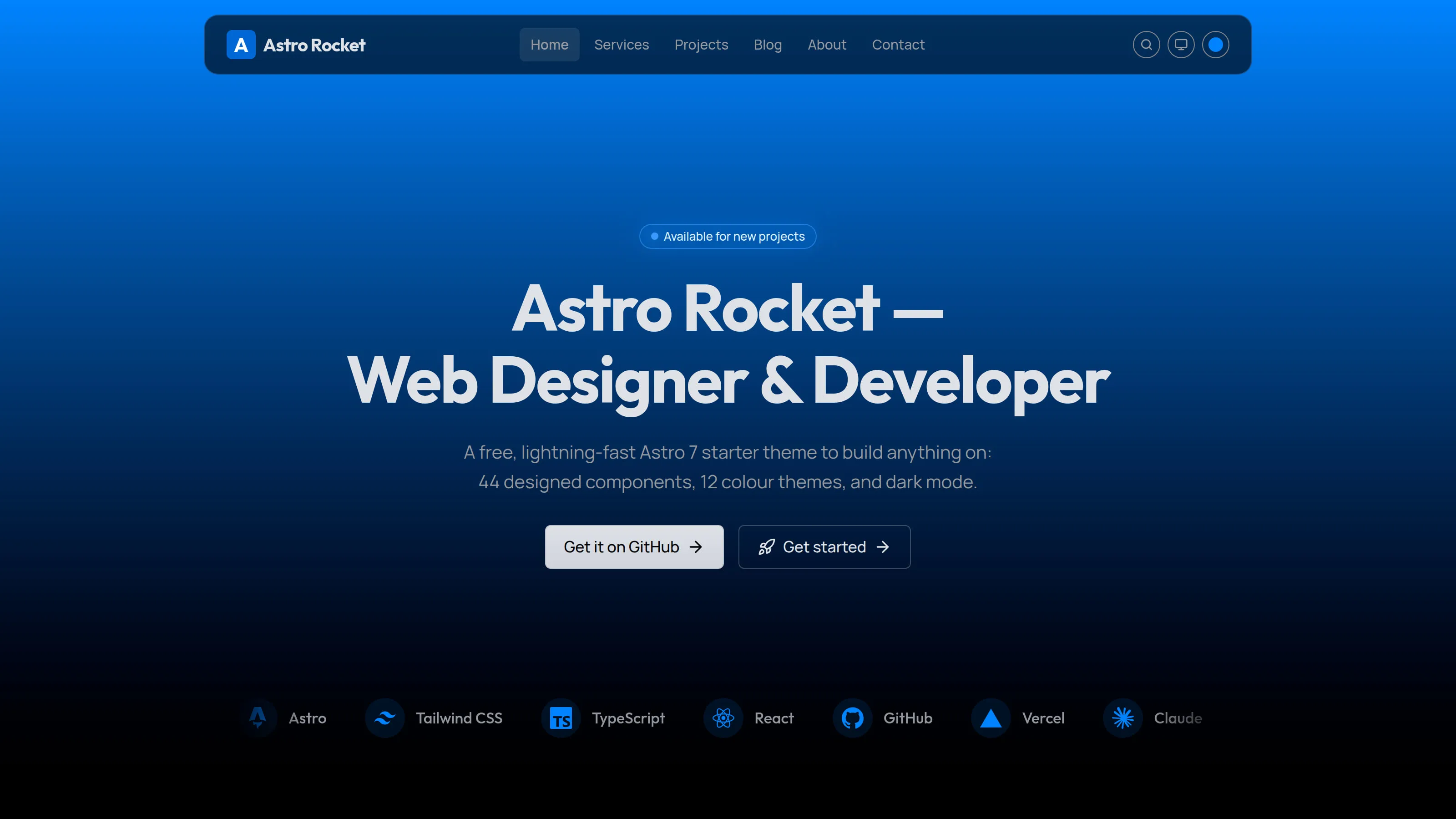
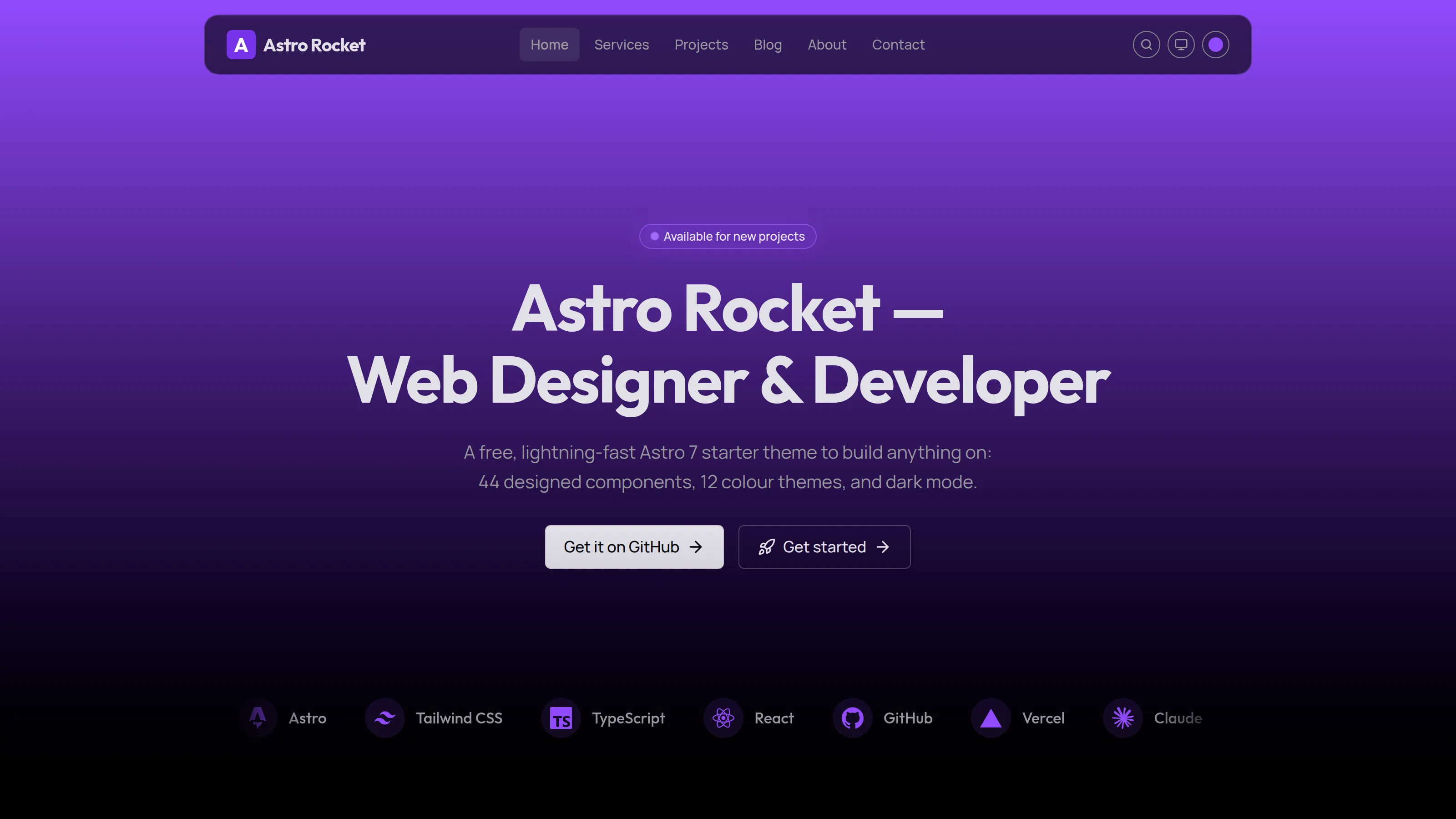
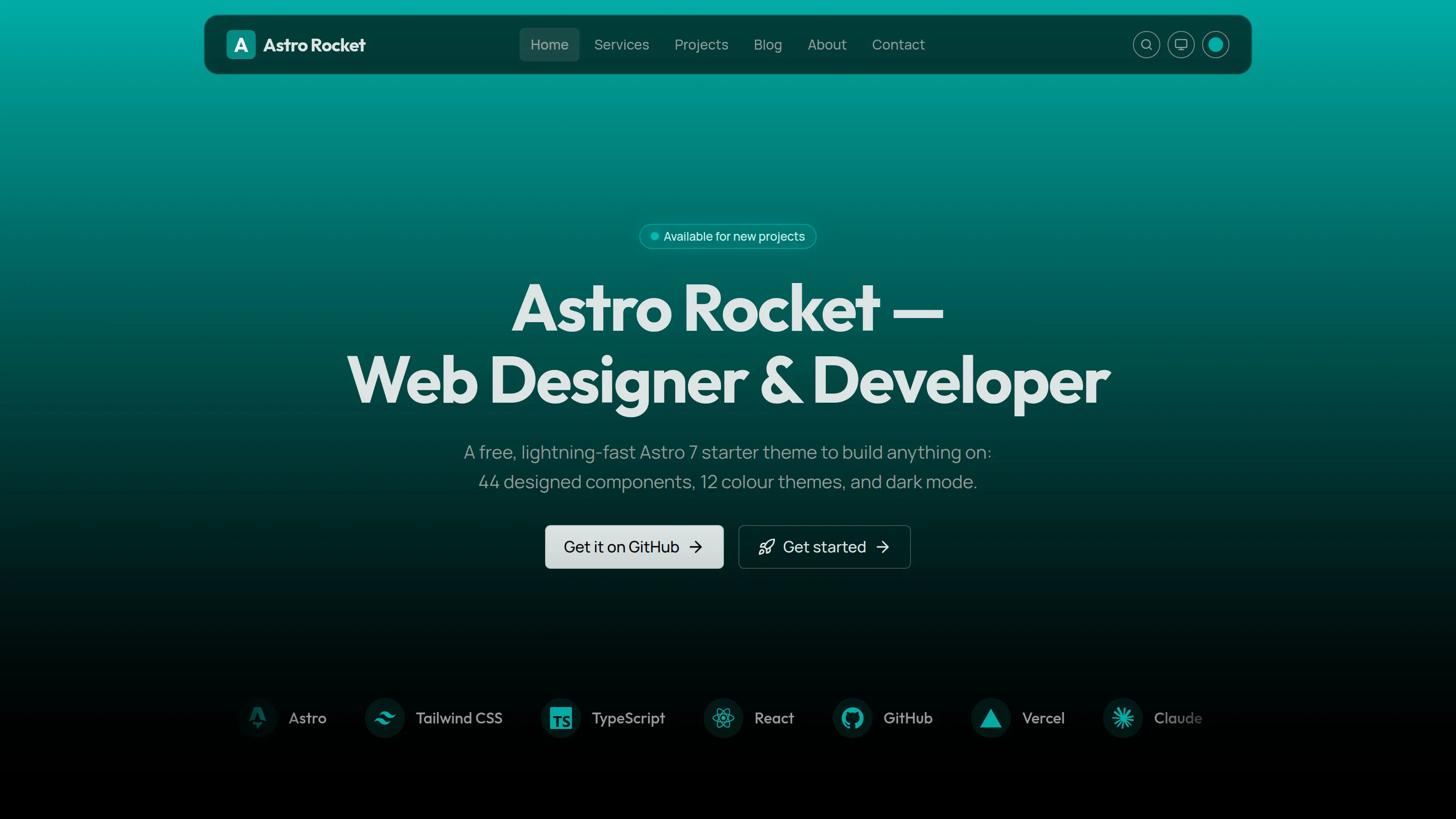
The theme switcher is one of Astro Rocket’s most satisfying details. Twelve colour themes — Orange, Amber, Lime, Emerald, Teal, Cyan, Sky, Blue, Indigo, Violet, Purple, and Magenta — toggle instantly from a pill in the header. Click a swatch and every button, link, badge, progress bar, scroll-progress arc, logo monogram, blog cover gradient, and accent on the page updates in a single frame. No waiting, no code changes, no deploy.
The secret is CSS custom properties scoped to data-theme attributes on <html>. The browser does all the work — the server never needs to know. The full token system — how colours, spacing, and typography are wired together — is covered in How Astro Rocket’s Design System Works.
Colour Mode — System, Light, Dark
The colour-mode picker is a true 3-state system rather than a binary toggle. The user can pin Light or Dark explicitly, or pick System to delegate to the operating system — and when ‘System’ is active, the page tracks prefers-color-scheme live, flipping the moment the OS does without a reload. The choice persists in localStorage, so it survives reloads and new tabs.
The picker lives in the header as a pill-shaped dropdown right next to the colour-theme pill. It shows the icon for the currently chosen mode (monitor, sun, or moon), so the user can always see what they picked at a glance. Below the md breakpoint both pills hide from the header bar and reappear inside the mobile menu — selecting a mode in one updates the other instantly.
A small inline bootstrap script in <head> runs synchronously before body paint to apply the saved mode and resolve the .dark class, so there is never a flash of the wrong theme — even across navigations. The full implementation, the storage contract, and the no-flash bootstrap are written up in System, Light, Dark — How Astro Rocket’s Colour-Mode System Works.
Homepage Hero — One Treatment, Both Modes
The homepage hero is built around a single vertical gradient — brand-600 at the top fading to pure black at the bottom — that renders identically in light and dark mode. The choice is deliberate: the hero is the moment the brand has to land, and locking it to a fixed brand-to-black ramp means the headline reads with the same drama regardless of which mode the visitor’s OS prefers.
Foreground tokens inside the hero are remapped to a slightly dimmed, brand-tinted near-white — never pure #fff — so the H1, paragraph, primary CTA, focus rings, and the brand-pill badge all sit at the same perceived depth as the dark-mode version. The brand pill itself is a small piece of glass with a brand-400 border, a brand-500 inner tint, and a subtle outer glow, with a pulsing dot that mirrors the rhythm of the entrance animations.
A desktop-only radial grid pattern fades in behind the headline with a soft brand-coloured glow at the centre — pure CSS, zero runtime cost, automatically re-tinted when the active theme changes. On mobile it’s hidden entirely to keep small screens calm.
The Floating Header
The header is a frosted-glass pill that floats over the hero on scroll and slides up out of view when you scroll down — quietly returning the moment you scroll back. In light mode it reads as a dark-glass capsule at rest over the brand-to-black hero gradient, then flips to a clean white capsule the moment the page scrolls past the hero. In dark mode it does the inverse: dark glass at rest, brighter capsule on scroll. The transition is a single 300ms property animation, and the menu items, theme pills, and hamburger ease their colour right along with it.
On page load, the header drops in from above on its own spring entrance — cubic-bezier(0.22, 1.6, 0.36, 1) over 0.8 seconds, delayed 150ms so it lands just as the hero content is mid-rise. The from state mirrors the header’s auto-hide position exactly, so the entrance and the scroll-hide behaviour use the same transform values and never conflict.
57+ Components, Eight Categories
The component library is the core of the project. Every component is built for Astro, typed with TypeScript, styled with Tailwind CSS v4, dark-mode-aware, and theme-aware. Browse them all on the components page:
- Form — Button, Input, Textarea, Select, Checkbox, Radio, Switch, PasswordInput
- Data display — Card, Badge, Avatar, Table, Pagination, Progress, Skeleton
- Feedback — Alert, Toast, Tooltip
- Overlay — Dialog, Dropdown, Tabs, VerticalTabs, Accordion
- Marketing — Logo, CTA, NpmCopyButton, SocialProof, TerminalDemo
- Patterns — ContactForm, NewsletterForm, SearchInput, StatCard, FormField, EmptyState, LetterGlitchBand
- Landing — Hero, FeatureTabs, TechStack, Credibility, LighthouseScores
- SEO — SEO, JsonLd, Breadcrumbs, LanguageSwitcher
Underneath, the design system uses a three-tier token architecture (reference → semantic → component) so a single --brand-500 change cascades through every component without per-component overrides.
Auto-Generated Branding
Change siteConfig.name and the logo monogram badge and SVG favicon update at runtime — automatically, in the right brand colour, with no design tools required. The favicon is pre-rendered at build time directly from the config; the badge re-renders live the moment a visitor switches themes. This is the detail that makes Astro Rocket genuinely forkable: new name, new colour, new site. Every available toggle is documented in the configuration guide.
Iconify — 3,350+ Icons, One Component
A single Icon component covers the full Iconify catalogue: 350+ Lucide UI icons for every interface need, plus 3,000+ Simple Icons brand marks for tech-stack badges, social links, and credibility sections. One import, one prop, every icon — and only the ones you actually use end up in the bundle.
SEO — The Complete Stack
Most starters ship three meta tags and call it SEO. Astro Rocket ships the complete implementation:
- JSON-LD structured data —
WebSite,Organization, andPersonschemas on the homepage;BlogPostingon every post;Breadcrumbssite-wide — prerequisites for rich results in Google Search - Open Graph + Twitter Cards — full social metadata on every page, with post cover images wired in automatically
- Canonical URLs — constructed from the production domain, correct across staging and preview environments
hreflangalternates — emitted automatically from the SEO component for every locale on multilingual sites- Auto-generated sitemap — every page included at build time; submit once to Search Console
- Per-page robots control —
noindex/nofollowon any page via a prop - Search Console verification — Google and Bing codes via
.env, no template edits - Static OG image — a polished default Open Graph card serves as the social preview for every page; no build-time image generation required
The full setup — what each piece does, how to configure it, and what rich results it unlocks — is in SEO in Astro Rocket.
Internationalization — Native, Opt-In
As of v1.3.0, internationalization is built into Astro Rocket itself — no upstream CLI, no project regeneration, no content restructure. Flip enabled: true in src/config/i18n.config.ts and the theme switches on:
- Locale-prefixed routes wired through Astro’s native
i18nconfig —/en/blog/...,/nl/blog/... LanguageSwitcherdropdown in the desktop header and the mobile menu — accessible, keyboard-navigable, pure HTML<a hreflang lang>links, ~1 KB of inline JS for open/closehreflangalternates emitted automatically by the SEO component for every configured localet()translation helper backed by JSON dictionaries atsrc/i18n/<locale>.json, with{name}placeholder interpolation and graceful fallback to the default locale, then to the key itself, so partial translations are visible but never crash a render- Per-locale content — every collection schema carries a
localefield, and blog posts live insrc/content/blog/<locale>/... - Optional browser-locale detection via the
detectBrowserLocaleflag
English and Dutch ship out of the box. Adding a language is two files: a new entry in src/config/i18n.config.ts and a matching src/i18n/<code>.json. When i18n is disabled (the default), every i18n code path is gated out — bundle size, output HTML, and hreflang count are identical to a single-locale build.
Blog Reading Experience
Long-form posts ship with two optional reading aids that activate with a single config flag. Both are off by default, so existing sites are unchanged on upgrade.
Table of contents. Auto-generated from the MDX headings of every post, with three layouts to choose from: an inline card at the top of the article, a sticky sidebar to the right on desktop, or auto — sidebar on xl+ viewports and inline card on phones and tablets. The reading column stays at max-w-4xl in every mode, so reading width never changes when the sidebar appears or disappears. An IntersectionObserver scroll-spy highlights the active section as the reader moves through the post. Per-post toc: false in frontmatter hides the TOC on a single post. Full setup: Table of Contents — Reading Anchors for Long Posts.
Discussions via Giscus. Comments at the bottom of articles powered by Giscus and GitHub Discussions — no database, no third-party account, no ads. The script is lazy-loaded with an IntersectionObserver, so readers who don’t scroll to the comments section pay zero network cost; a reserved min-height on the placeholder prevents cumulative layout shift. Per-post comments: false in frontmatter hides comments on a single post. Full setup: Comments on Blog Posts — Giscus, Lazy-Loaded.
Independent Header & Footer Menus
Header and footer navigation are configured separately, so a new Privacy or Imprint link can land in the footer without cluttering the main nav. nav.config.ts exports three arrays: navItems for the header, footerNavItems for the footer, and legalLinks for the small legal-style row some footer layouts render in their bottom strip. Defaults mirror the existing nav, so footers on existing sites are unchanged on upgrade. Full setup: Independent Footer Menu — Different Links in Header and Footer.
Cursor Trail — Desktop Only
A custom three-layer cursor effect activates only on devices with a fine pointer and no prefers-reduced-motion:
- A small brand-coloured dot that sits exactly under the pointer
- A lagging ring that follows with elastic easing and blooms when hovering interactive elements
- A comet trail of fading particles that spawn behind movement and dissolve
The native cursor stays visible — the effect is purely additive. On touch devices, coarse pointers, and reduced-motion sessions it’s skipped entirely, with no JavaScript cost.
Animations
Scroll progress bar. A 2px brand-coloured line runs along the bottom of the fixed header and fills as you scroll. Smooth, passive, requestAnimationFrame-throttled.
Scroll progress ring. As you scroll, a thin arc traces around the back-to-top button — clockwise, from empty at the top to fully drawn at the bottom. The arc colour follows the active theme automatically.
Hero scroll indicator. Two stacked chevrons gently bounce at the bottom of the homepage hero, drawing the eye downward. They appear after the hero has finished animating in and vanish the moment you start scrolling — desktop-only, zero intrusion.
Typing effect. The hero headline cycles through configurable phrases. The width is locked to the longest word before the animation starts, using a hidden off-screen measurer that inherits the exact computed font metrics — so the layout never shifts. A Core Web Vitals detail most typing effects get wrong.
Scroll reveal. Three distinct modes handle every case. data-reveal animates a single element into view with direction variants for up, down, left, right, and scale. data-reveal-children cascades a grid of cards in sequence, each child staggering 100ms behind the last. data-reveal-content gives long-form pages like blog posts and project write-ups a per-block reveal. All three modes use an IntersectionObserver with a 15% threshold, so the animation plays when the element is genuinely on screen.
Spring curve. Every entrance uses cubic-bezier(0.22, 1.6, 0.36, 1) — a curve with the second control point above 1.0, which produces a controlled overshoot. The element travels a few pixels past its final position and snaps back, approximating a physics spring without any runtime library. This is the single detail that separates the animation feel from a standard ease-out: things arrive rather than stop.
Hero entrance stagger. On page load the hero content cascades in element by element — badge, title, description, action buttons — each 90ms behind the last, all driven by :nth-child selectors on a single parent class. No JavaScript scheduling, no component props.
Counter animations. Stat counters and Lighthouse scores ease from zero to their target value the moment they enter the viewport, with cubic ease-out timing tied to a single IntersectionObserver.
Card and tile micro-interactions. Project cards, blog cards, and the about-me tiles all lift on hover with a 1px translate, a softer shadow, and a brand-coloured top-border accent that fades in — small details that make the grid feel responsive without being noisy.
Reduced motion. Every animation respects prefers-reduced-motion. When the user opts out, entrances become instant, the cursor trail is skipped, and the typing effect falls back to the longest phrase rendered statically.
A full technical breakdown of every animation layer is in Animations in Astro Rocket.
LetterGlitch CTA
The closing call-to-action on the homepage, projects index, and about page uses a contained LetterGlitch band on desktop — a field of randomised characters cycling at the brand colour, with a centred glass card laid over the top holding the headline and buttons. It’s a deliberate moment of visual texture in an otherwise restrained layout, and on mobile it gracefully degrades to a flat brand-coloured section so small screens stay calm.
Forms — Wired End-to-End
Contact form. A fully working form with Zod schema validation, honeypot bot detection, and a Resend-powered email handler. Submissions arrive in your inbox within seconds; setup is a single environment variable and one verified domain. The full walk-through is in Set up the contact form with Resend.
Newsletter form. A drop-in newsletter component wired to Resend Audiences — visitors are added to your mailing list directly from the site with the same Zod-validated handler.
Both endpoints are real Astro API routes, type-checked, unit-tested with Vitest, and ready to deploy.
Search, Privacy, and Analytics
Pagefind search. Static-site search powered by Pagefind — index built at the end of every production build, no server, no third-party dependency, no per-search cost.
Cookie consent banner. A GDPR-friendly banner with Google Consent Mode v2 support — analytics and ad tags wait for explicit consent before firing, and the user’s choice persists in localStorage.
GA4 + GTM. Google Analytics 4 and Google Tag Manager are pre-wired and consent-aware. Add your IDs via .env and the tags load only when the visitor has consented.
Content Collections — Type-Safe by Default
Every piece of content lives in a typed Astro Content Collection: blog, projects, pages, authors, faqs, and stack. Schemas are validated with Zod at build time, so a missing field, a malformed date, or an invalid image path is a build error — not a runtime surprise. Every collection carries a locale field, so multilingual content is a first-class citizen rather than a bolt-on.
Deploy Anywhere
Astro Rocket ships with first-party configuration for Vercel, Netlify, and Cloudflare Pages — vercel.json, netlify.toml, and wrangler.toml are all in the repo, each with security headers pre-configured. CI runs lint, type-check, and build on every push via GitHub Actions.
Zero JavaScript by Default
Astro’s island architecture means every page ships pure HTML unless a component explicitly needs JavaScript. Interactive islands — theme switcher, colour-mode picker, contact form, typing effect, scroll indicators, cursor trail, LetterGlitch, LanguageSwitcher — hydrate themselves. Everything else stays static.
Open Source
Astro Rocket is open source under the MIT licence and submitted to the official Astro themes directory. It’s a fork of and a tribute to Velocity by Southwell Media — the foundation it builds on. If it saves you a week of setup, a star on GitHub is the best way to say thanks.